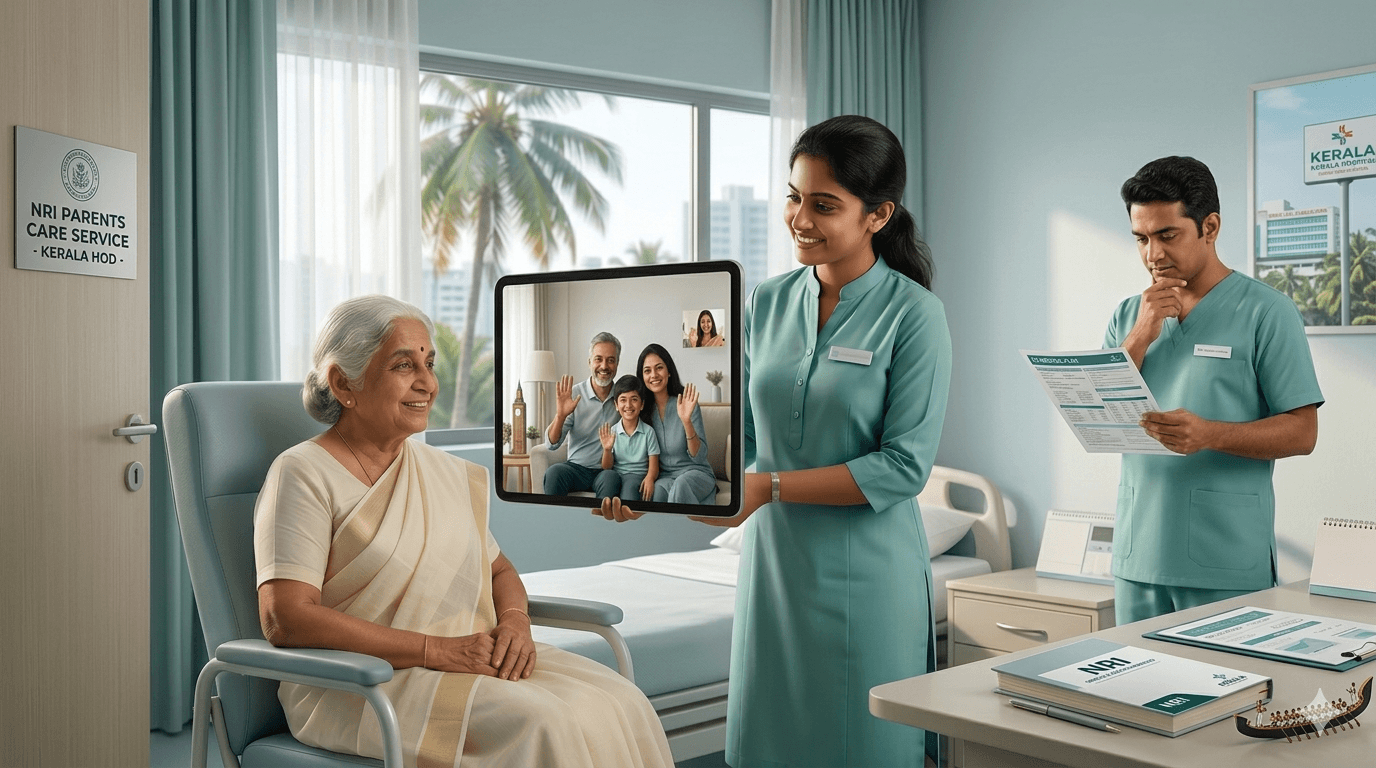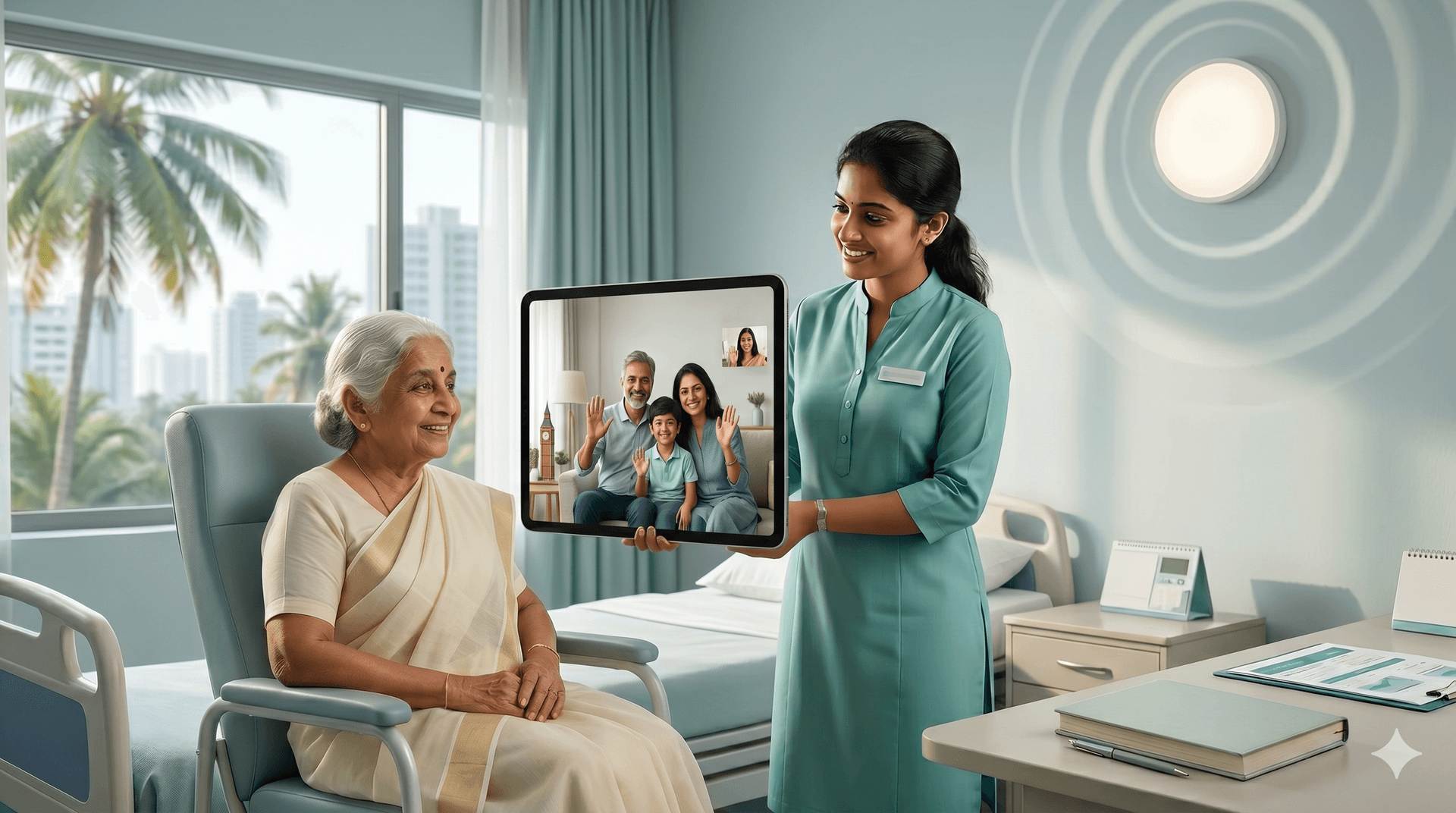
Families searching for location-specific support can also review our Kochi companion service details and then continue with this guide.
Managing elderly parents' healthcare in Kerala from the Gulf.
Time zones, distance, and communication gaps make it hard. A professional companion bridges the gap.
If you're a Malayali family in the Gulf - whether you're in UAE, Saudi Arabia, Qatar, Kuwait, Bahrain, or Oman - managing your elderly parents' healthcare back in Kerala is a persistent background anxiety. They have a doctor's appointment in Kochi. You're in Dubai. Your mother calls asking what to do. Your father goes to the hospital and calls back with medical information you don't fully understand. You're 8 hours ahead of Kerala time. You can't leave work for an appointment. You're balancing your career, your family, and your aging parents across thousands of kilometers.
This guide is written specifically for Gulf NRI families managing parents' hospital visits in Kerala. It covers the time zone reality, communication strategies, what information matters, and how professional support can bridge the distance.
The Gulf NRI Reality
Malayali families in the Gulf are unique. You're not recent expats - many of you have been in the Gulf for 15+ years. Your parents are aging in Kerala while you're building careers and families in the UAE, Saudi Arabia, or Qatar. You're financially stable enough to help with healthcare costs, but emotionally caught between your life in the Gulf and your responsibility to aging parents back home.
The healthcare moment is when this tension peaks: Your parent needs to see a cardiologist. They're confused about what time to go. They don't know how to get to the hospital. They might not fully understand the doctor's instructions. And you're in Dubai, sleeping while they're having the appointment, unable to help in real time.
Time Zone Challenges
The Gulf and Kerala operate on very different schedules:
UAE (Dubai, Abu Dhabi)
- 4 hours ahead of Kerala
- Morning in Kerala = still night/early morning in UAE
- Hospital appointments are typically 9 AM - 4 PM Kerala time
- 1 PM Kerala appointment = 5 PM UAE time
Saudi Arabia
- 2.5 hours ahead of Kerala
- 11 AM Kerala appointment = 1:30 PM Saudi time (during work day)
Qatar
- 3 hours ahead of Kerala
- 2 PM Kerala appointment = 5 PM Qatar time
Kuwait, Bahrain, Oman - similar to UAE/Saudi timing
The Time Zone Problem
Even if you want to stay connected during your parent's hospital visit, the timing often doesn't align with your work day. A 9 AM appointment in Kochi is 1 PM in UAE - smack in the middle of your workday. You can't step out for constant updates.
Solution: Asynchronous communication. You don't need real-time minute-by-minute updates. You need a complete summary within 2-3 hours, after the visit is done, when you're done with work.
Communication Gaps
When you're managing a parent's healthcare from the Gulf, communication is the critical link:
The Current Reality (Unstructured)
Your parent goes to the hospital. They call you from the waiting room: "Beta, we're here. The doctor said something but I didn't understand."
You're at work. You're on a call. You can't listen carefully. You promise to call back.
They call back: "The doctor said I need to take some medicine and something about tests."
You: "What medicine? What tests?"
Them: "I don't know, they gave me some papers."
Hours later, you find time to call back. They've lost the papers. You're now coordinating via incomplete information.
What Information Actually Matters
From 8,000 km away, you don't need to know about every detail of the hospital visit. You need:
- Doctor's diagnosis - what did they find?
- Medications - names, dosages, timing, duration (photos of prescriptions are helpful)
- Activity restrictions - what can your parent do/not do?
- Warning symptoms - when should they seek emergency care?
- Follow-up appointments - next doctor visit, tests needed, dates
- Any complications - unexpected findings, need for admission, unexpected costs
Everything else is noise. You don't need to know the hospital's wifi password or what the waiting room was like.
Strategies for Managing From the Gulf
Strategy 1: Structured Pre-Visit Briefing
Before your parent's hospital visit, have a clear conversation:
You call your parent the evening before the appointment:
- Confirm the hospital name, address, appointment time
- Confirm who is taking them (family member, taxi, you've arranged a companion)
- Write down the doctor's name and department
- List any questions: "Ask about medication side effects," "Ask about exercise restrictions," etc.
- Agree on communication plan: "I'll call you after 6 PM Gulf time"
Write it down. Don't assume verbal instructions will be remembered.
Strategy 2: Designated Family Point-Person in Kerala
If you have a sibling, cousin, or close family member in Kerala, make them the primary point-person:
- They accompany your parent to the hospital
- They take notes
- They relay information to you after the visit
- They handle follow-up coordination
This removes the burden from your parent to be the information relay.
Strategy 3: Professional Companion Service (Presenza)
A professional hospital companion in Kochi serves the exact purpose NRI families need:
What they do:
- Pick up your parent from home
- Stay throughout the hospital visit
- Take clear notes on doctor's findings, medications, restrictions, follow-up dates
- Provide real-time WhatsApp updates during the visit (so you can check during a break)
- Deliver a complete post-visit summary within 30 minutes of discharge
- Photograph prescriptions so you have clear records
Why it solves the NRI problem:
- Your parent doesn't have to remember anything - the companion documents it
- You don't have to keep calling back asking "What did the doctor say?" - you get a complete summary
- You have exact information for coordinating follow-up care or second opinions
- Your parent feels supported and less anxious (someone trained is there, not just a taxi driver)
- You can ask follow-up questions via WhatsApp based on the written summary
Time zone advantage: The summary arrives while you're still in the evening of your Gulf workday. You have concrete information to act on.
Strategy 4: WhatsApp as the Communication Tool
Regardless of which support model you use, WhatsApp is your tool:
- Before visit: WhatsApp your parent or the person accompanying them with hospital details and questions
- During visit: Companion (if using one) sends updates via WhatsApp as things progress
- After visit: You receive the post-visit summary on WhatsApp, can read it at your pace, and ask clarifying questions over chat (no need for phone calls)
WhatsApp accommodates time zone differences. You can read the message when you're free, not when they send it.
Healthcare Coordination Across Distances
Handling Medical Information
When you're managing from the Gulf, keep a system:
- Photos of prescriptions - clear pictures of all medication labels, sent via WhatsApp
- Doctor's notes or discharge summary - ask for written copies, photograph them
- Test reports - many Kochi hospitals email reports; ask to be CC'd
- Appointment records - collect doctor's names, departments, follow-up dates in one WhatsApp group or note
This creates a medical record you can reference when arranging follow-up care, second opinions, or communicating with doctors in the Gulf (if you're consulting them).
Arranging Follow-Up Care
Once you have clear information from the hospital visit:
If your parent needs ongoing care (e.g., cardiology follow-up every 3 months):
- Use a professional companion service for each visit
- Ask them to book the next appointment before leaving
- Set a calendar reminder 6 weeks before to book the companion again
If your parent needs a second opinion:
- Take the diagnosis, test results, and doctor's recommendations
- Share via WhatsApp with a doctor friend in the Gulf or a telemedicine platform
- Get second opinion input
- Relay guidance back to your parent's Kerala doctor
If your parent needs medication refills:
- Ask the companion to coordinate pharmacy pickups
- Have medications mailed to your parent if needed
- Confirm delivery and proper storage
The Cost-Benefit Analysis for Gulf NRIs
Many Gulf NRIs initially balk at the cost of a professional companion service (₹1,500-₹3,000 per visit):
But consider the alternative cost:
- Your peace of mind has value
- Hours of stress and follow-up calls = your time cost
- Medical errors from miscommunication = potential health and financial costs
- Your parent's anxiety during hospital visit = emotional and health cost
A professional companion visit costs roughly what you'd spend on an international phone call to your parents plus a coffee. The value - complete, accurate information and your parent's reduced anxiety - is disproportionate.
Special Situations for Gulf NRI Families
If Your Parent Goes to the ER
For emergencies, have a plan:
- Designated contact in Kerala: Someone (sibling, cousin) who can respond within 30 minutes and go to the hospital
- Insurance information: Ensure your parent carries insurance cards
- Medical history: Keep a written summary (conditions, medications, allergies) that your parent carries or the emergency contact has access to
- Hospital preference: If your parent has a preferred hospital, discuss it in advance
Call the emergency contact, not your parent (who may be in pain or confused). Your contact will update you after assessing the situation.
If Your Parent Needs Surgery
For planned surgeries:
- Pre-surgery consultation: Book a professional companion for the pre-op appointment
- Day of surgery: Another companion or family member to be at the hospital during surgery (for intake, consent, post-op handoff)
- Post-op follow-up: Companions for each post-op visit
Surgery creates complex information (surgical details, anesthesia notes, post-op restrictions, physical therapy). A professional companion ensures this information reaches you accurately.
If Your Parent Refuses Help
Some elderly parents are proud and resist "paying a stranger" to accompany them to the hospital:
Reframe it: "I'm hiring them so I can stay in touch with what's happening. They're helping me, not replacing you."
Emphasize independence: "You go to the appointment; they just make sure I know how it went."
Appeal to their concern for you: "It gives me peace of mind."
Most parents will accept this framing.
Building a Sustainable System
If you're a Gulf NRI with elderly parents in Kerala, you need a sustainable system for managing healthcare, not ad-hoc approaches:
The Recommended System
- Schedule regular health checkups (every 6-12 months, depending on age and health)
- Book professional companion visits in advance using a service like Presenza
- Receive complete post-visit summaries 30 minutes after each visit
- Maintain a shared medical record (WhatsApp group or shared document with family)
- Coordinate follow-up based on actual doctor findings, not guesswork
- Stay informed without constant calls or anxiety
The Cost
A professional companion service for regular elderly parent health management in Kerala costs:
- 1 visit/quarter = ₹6,000-₹12,000/year
- 1 visit/month = ₹18,000-₹36,000/year
This is modest compared to:
- International airfare if you fly back (₹40,000-₹100,000+)
- Your missed work days (if you took leave for each visit)
- Your stress and anxiety (which is the biggest cost, and this reduces it)
Summary: Bridging the Distance
Managing elderly parents' healthcare from the Gulf is doable. It requires:
- Clear communication structures - not ad-hoc phone calls
- Designated support in Kerala - either family or professional companion
- Written documentation - photos of prescriptions, summaries, follow-up dates
- Asynchronous coordination - expect summaries after work, not during
- Peace of mind - knowing your parent is supported by trained professionals
For Gulf NRI families, a professional companion service isn't a luxury. It's the bridge between your career in the Gulf and your responsibility to aging parents in Kerala. It ensures your parent never navigates hospitals alone, and you're never left guessing what the doctor said.
When Presenza launches in Bangalore or expands to other Kerala cities, the same service will be available across India for NRI families managing parents' care wherever they are.
Real-time updates and complete documentation, asynchronously.
Your parent gets support. You get information. All via WhatsApp, on your schedule.
Frequently Asked Questions
Arrange professional support for your parent's hospital visits in Kerala.
Message us on WhatsApp to book. Companions speak Malayalam, English, Hindi, and Tamil.
Presenza's care team writes practical guides for families managing elderly hospital visits and remote healthcare coordination.
Get our hospital visit checklist for families.
A practical guide to preparing for appointments, questions to ask doctors, and what to document. Free. No spam.