Families searching for location-specific support can also review our Kochi companion service details and then continue with this guide.
Hospital choice should match your budget and timeline.
We help families compare private and government options and choose based on their circumstances.
Families choosing hospitals for elderly parents often face a real decision: government hospitals (public, subsidized by the state) or private hospitals. Each has genuine advantages and real tradeoffs. Understanding these differences helps families make informed choices aligned with their circumstances, priorities, and budget.
This guide compares private and government hospitals in Kerala, examining cost, quality, waiting times, specialist access, and practical considerations for elderly patient care.
Government Hospitals in Kerala: Strengths
Extremely affordable: Government hospitals charge significantly less than private hospitals, sometimes as little as one-tenth of the private cost. For families with limited budgets, government hospitals make specialist and surgical care accessible. This affordability extends to medications: government hospital pharmacies charge less, and many medications are subsidised or provided free.
Universal access: Government hospitals must accept all patients regardless of ability to pay. There is no requirement for upfront payment or insurance coverage. Patients can defer payment or arrange installments.
Experienced specialists: Government hospitals in Kerala, particularly the Medical College Hospital in Kochi, employ highly experienced doctors who have treated thousands of complex patients. These specialists are often acknowledged leaders in their fields across the state.
Established infrastructure: Major government hospitals have decades of established systems for managing large patient volumes. The infrastructure is basic but functional and well-tested.
Teaching hospital environment: Many government hospitals are affiliated with medical colleges. This brings ongoing medical education and research, which keeps specialists current and exposes them to the full range of clinical presentations.
Government Hospitals in Kerala: Limitations
Long waiting lists: Government hospitals are extremely busy. Outpatient appointments may require waiting 1-2 months. Emergency care is correctly prioritised, but non-urgent specialist appointments have significant delays.
Variable quality by department and doctor: Some departments are excellent; others struggle with consistency. Quality can vary significantly depending on the specific doctor and the specialty.
Basic ward conditions: Ward infrastructure is functional but basic. Ward accommodation is often shared with limited privacy. Patient amenities such as air conditioning, Wi-Fi, and food quality are minimal compared to private hospitals.
Reduced family involvement: Many government hospitals have strict visiting hours and limit family presence. This can be particularly hard for elderly patients who need family reassurance and practical support.
Medication availability variability: While government hospitals stock common medications, newer specialty medications may not always be available on-site. Patients may need to purchase these from outside pharmacies.
Communication time is limited: In busy government hospital settings, doctors have less time per patient. Explanation of diagnosis and treatment plans may be brief. Families who need detailed discussions often find this frustrating.
Private Hospitals in Kerala: Strengths
Short waiting times: Private hospitals typically see patients within days. Specialist appointments can usually be scheduled within a week. Multi-month waits are uncommon.
High amenity standards: Private hospitals provide air-conditioned rooms, better food, privacy, comfortable furnishings, and services designed for patient comfort.
Flexible family involvement: Most private hospitals allow family members to stay with the patient or be present during consultations and procedures. Visiting hours are generally generous.
Advanced technology: Private hospitals typically have newer imaging equipment, advanced laboratory capabilities, and modern operating rooms with up-to-date instruments.
Medication availability: Private hospitals stock a wide range of medications and can typically provide any required medication on-site without the patient needing to purchase from an outside pharmacy.
Better communication: Private hospitals invest in patient communication. Doctors generally spend more time explaining diagnosis, treatment plans, and prognosis. This matters significantly for elderly patients and their families managing care remotely.
Scheduled procedures at convenient times: Surgical procedures are typically scheduled at mutually agreed times rather than on the basis of unpredictable operating room availability.
Private Hospitals in Kerala: Limitations
High cost: Private hospital costs are substantially higher than government hospitals. Room charges, specialist fees, procedure charges, and medication costs accumulate quickly. A week-long hospitalisation can cost Rs. 1,00,000-3,00,000 or more depending on the hospital and condition.
Insurance dependence: Without insurance, private hospital costs can be financially catastrophic. Even with insurance, co-payments and non-covered services add up.
Variable specialist expertise for rare conditions: While private hospitals have strong specialists in common areas, for very rare or complex conditions some government teaching hospitals may have more concentrated expertise.
Profit motive: Private hospitals operate for profit. There is sometimes pressure to recommend additional tests or procedures that may not be strictly necessary. Families must ask hard questions about the necessity of each recommendation.
Cost Comparison: Typical Scenarios in Kochi
Outpatient specialist visit:
- Government hospital: Rs. 100-200
- Private hospital: Rs. 1,000-2,000
Basic blood work panel:
- Government hospital: Rs. 100-500 total
- Private hospital: Rs. 1,000-3,000 total
Imaging (X-ray, ultrasound):
- Government hospital: Rs. 100-500
- Private hospital: Rs. 500-2,000
Simple surgical procedure such as hernia repair:
- Government hospital: Rs. 20,000-40,000 total
- Private hospital: Rs. 1,50,000-3,00,000 total
Complex surgery such as cardiac bypass:
- Government hospital: Rs. 1,00,000-2,00,000 total
- Private hospital: Rs. 5,00,000-10,00,000 or more
Hospital ward stay per night:
- Government hospital: Rs. 200-500
- Private hospital: Rs. 5,000-15,000
How to Choose: A Decision Framework
If cost is the primary constraint: Government hospitals make care accessible when budget is limited. Accept longer waits and basic amenities as the tradeoff for genuine affordability.
If your parent has good insurance: Private hospitals offer shorter waits and better amenities. If insurance covers most costs, the higher price is offset and the choice becomes one of comfort and communication quality.
If the condition is urgent or serious: Consider private hospitals. Shorter waits and direct specialist access can result in faster diagnosis and earlier treatment, which matters for acute conditions.
If the condition is stable and non-urgent: Government hospitals are a reasonable choice. Longer wait times matter less when urgent diagnosis is not required.
If your parent is frail or needs family support: Private hospitals' generous family involvement policies and patient comfort environment may be worth the higher cost for elderly patients who struggle with institutional settings.
If the specialty required is very rare: Government teaching hospitals sometimes have more concentrated expertise in uncommon conditions because they see higher volumes from across the state. Ask specifically about the hospital's volume of your parent's specific procedure.
Hybrid Approach: Using Both Systems
Some families use both systems strategically to control costs while maintaining quality:
Diagnostics in government hospital, treatment at private: Get basic tests and preliminary diagnosis done at lower cost, then take results to a private specialist for the treatment plan and procedure.
Surgery at government hospital, follow-up at private: Have the surgical procedure done at a government hospital (at a fraction of the cost) and then arrange post-operative follow-up with a private specialist for more detailed monitoring and communication.
Routine care at government, emergencies at private: Use government hospitals for planned appointments and stable condition management, but go to the nearest private hospital for emergencies where speed of access matters.
This hybrid approach uses the genuine strengths of both systems.
Questions to Ask Before Choosing a Hospital
Regardless of whether you are considering a government or private hospital, ask these questions before committing.
Also see our article on top hospitals in Kochi for specific facility information and our complete hospital visit preparation checklist once you have chosen.
- Does this hospital have a specialist with experience in my parent's specific condition?
- How many patients with this condition does this hospital treat per year?
- What is the estimated total cost, and what is and is not covered by insurance?
- Can family members stay with the patient or visit freely during the hospital stay?
- How will we be kept informed about my parent's condition and treatment decisions?
- What is the discharge and follow-up process?
- Is the hospital accessible by transport for my parent?
- If a complication arises after discharge, which department should we contact?
NRI Families: Managing Hospital Selection from Abroad
For families living outside India, choosing a hospital for an elderly parent in Kochi requires a different approach:
Do not rely solely on online reviews: Hospital reviews online are often emotional responses to isolated experiences rather than systematic assessments of clinical quality. They are useful for understanding patient experience but not for evaluating clinical outcomes.
Ask a trusted local contact: A relative, family doctor, or professional companion service with experience across Kochi hospitals can give practical, current information about which hospitals perform well for specific conditions.
Establish communication protocols before admission: Before your parent is admitted, confirm with the hospital how they will communicate with family members abroad. Ask for a single point of contact rather than navigating different departments. Private hospitals generally accommodate international families better than government hospitals for communication.
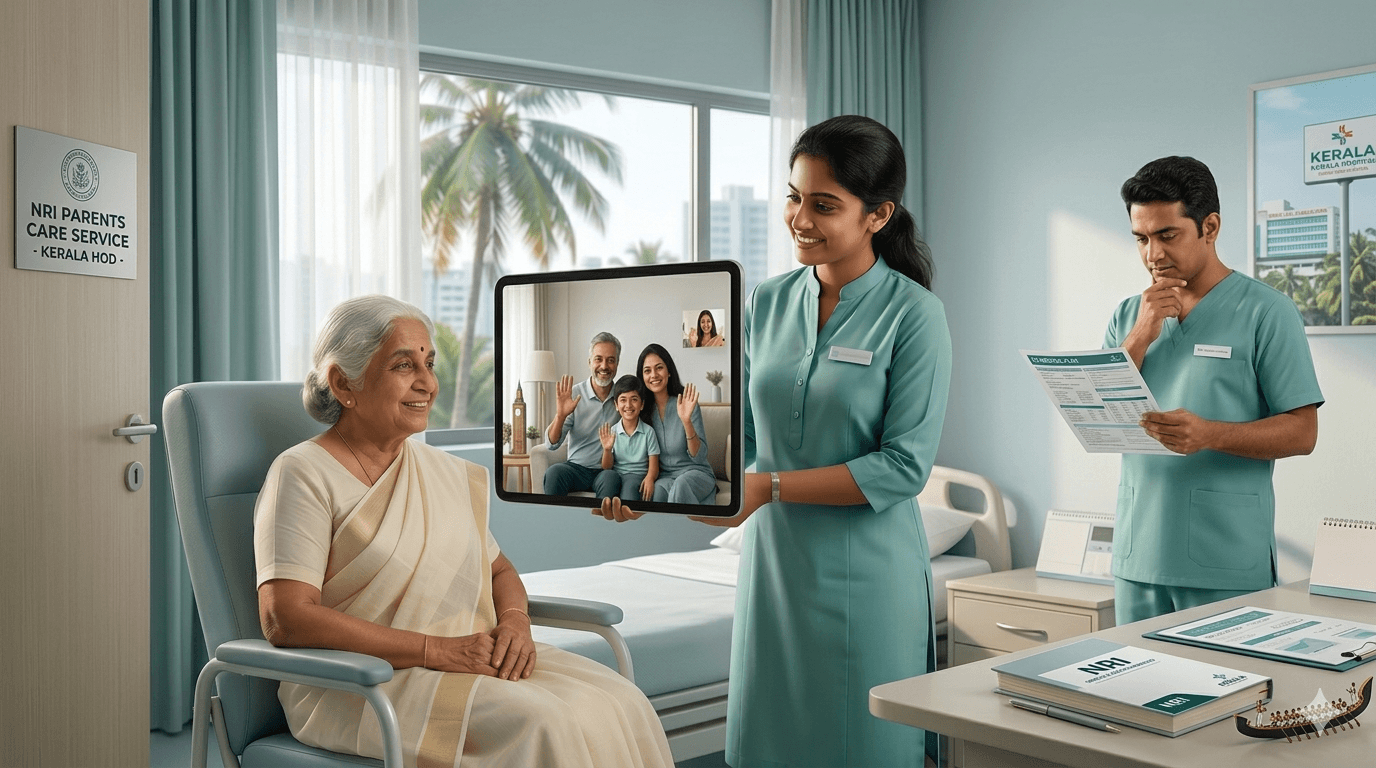
Consider a hospital companion service: For NRI families who cannot be physically present, a trained companion who accompanies your parent, attends all consultations, takes notes, and reports back in detail is often more valuable than choosing one hospital over another.
Insurance verification matters: If your parent has insurance coverage, verify which Kochi hospitals have cashless facilities before admission. Cashless means the insurer pays the hospital directly rather than your parent paying upfront and claiming reimbursement later. This is a practical and significant consideration for families managing finances from abroad.
For families managing care from outside Kerala, our Kochi companion service can advise on appropriate hospital selection for your parent's condition, arrange appointments at either government or private hospitals, and coordinate your parent's care.
This article is for informational purposes only. Hospital selection should be based on your parent's medical condition and your family's specific circumstances. For our editorial standards, see our editorial policy.
Both systems have strengths - the right choice depends on your situation.
We guide families through the decision-making process transparently.
Frequently Asked Questions
Uncertain which hospital is right for your parent?
Contact us and we will help you choose based on your parent's needs and your budget.
Presenza's care team writes practical guides for families managing elderly hospital visits and remote healthcare coordination.
Get our hospital visit checklist for families.
A practical guide to preparing for appointments, questions to ask doctors, and what to document. Free. No spam.