Families searching for location-specific support can also review our Kochi companion service details and then continue with this guide.
Planning a Rajagiri visit for your parent?
We help with door-to-door accompaniment and practical hospital coordination.
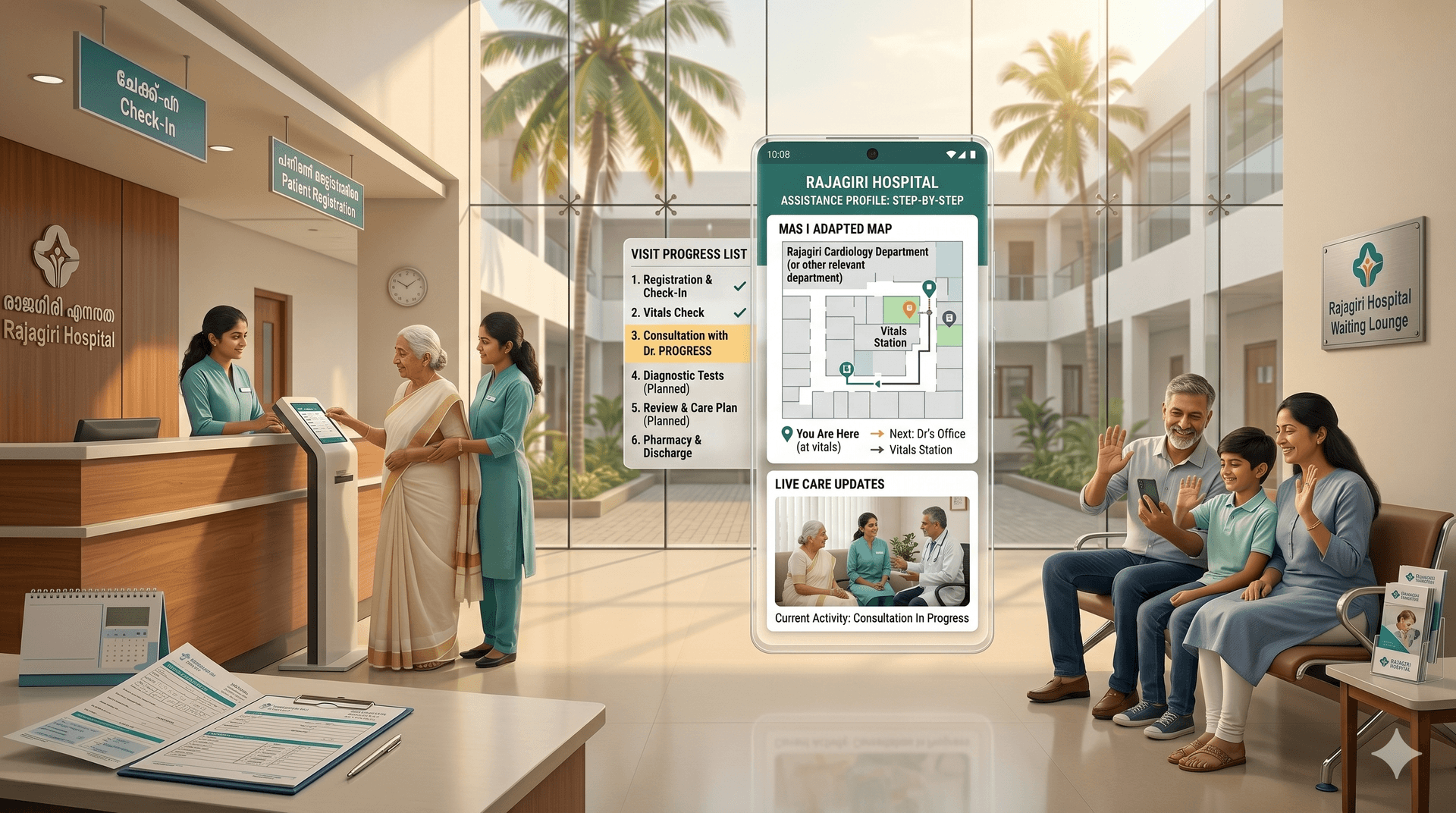
Rajagiri visits can involve several counters and transitions even for routine consultations. For many seniors, that is where fatigue and confusion begin.
A step-by-step support workflow helps families reduce uncertainty before the appointment day.
Step 1: Appointment and Context Capture
Confirm department, appointment time, and expected tests. Collect prior reports and medication details in one concise brief.
This avoids repeated explanation during the visit.
Step 2: Home Pickup and Arrival Support
The companion arrives before departure, supports safe boarding, and ensures timely arrival at Rajagiri.
Early arrival reduces queue pressure and helps keep the visit orderly.
Step 3: Consultation and On-Ground Coordination
Companions assist with movement between counters, diagnostics, and billing while the parent stays supported throughout.
If doctors advise additional tests or follow-up, the family is informed immediately.
Step 4: Return Home and Summary
After pharmacy and discharge steps, the companion travels back home with the parent. Families receive a post-visit summary with essential next steps.
This final summary helps children coordinate care from anywhere.
The Emotional Reality Families Rarely Say Out Loud
Many adult children carry quiet guilt when they cannot be physically present for every hospital visit. You may be managing work deadlines, visa constraints, childcare, or distance across time zones, while still trying to be deeply involved in your parent’s care. That emotional load is real. Families are not just looking for logistics. They are looking for reassurance that their parent will be treated with dignity, patience, and attention at every point of the visit.
In our experience, the most helpful care model respects both sides of the relationship. Parents need confidence and comfort in the hospital environment, and children need reliable visibility into what is happening in real time. When both are supported, stress drops significantly. Healthcare decisions become calmer, and families are able to focus on what matters instead of firefighting every step.
A helpful companion service should never make families feel they are handing responsibility away. Instead, it should feel like adding a dependable layer of support. The role is to strengthen family care, not replace it.
Why Hospital Visits Become Hard for Seniors Even When They Look "Fine"
Many seniors appear independent in daily life, but hospital systems demand a different kind of stamina. Long waiting periods, repeated movement between counters, complex instructions, and fast consultations can be exhausting. Even a routine outpatient appointment can involve registration, queue changes, diagnostic referrals, pharmacy coordination, and follow-up scheduling.
For older adults, fatigue can build quietly during these transitions. A parent may not mention discomfort because they do not want to worry their children. They may also hesitate to ask hospital staff repeated questions, especially in crowded settings. That is where misunderstandings happen: missed steps, incomplete medicine pickup, unclear follow-up dates, or delayed tests.
Professional accompaniment solves practical friction points that families cannot see from afar. Small interventions, done consistently, reduce the risk of confusion and improve care continuity.
A Standard Visit Framework Families Can Trust
The strongest visit journeys follow a predictable structure. First comes preparation: appointment details, known concerns, medication context, and communication preferences. Next comes safe movement: pickup from home, timely arrival, and support through the hospital journey. Then comes clarity: concise updates during key checkpoints and a complete summary after return home.
This structure matters more than promises. Families should evaluate providers by process quality: how clearly they communicate, how consistently they execute, and how transparently they handle changes.
A good framework includes contingency planning. If the doctor recommends an additional test, if queues are delayed, or if a parent feels tired mid-visit, there should be a calm escalation path that keeps the family informed and involved.
What Real-Time Updates Should Actually Look Like
Families often ask for "live updates," but too many updates can become noise. The best communication model is checkpoint-based and decision-focused. A useful update sequence usually includes: pickup complete, hospital arrival, consultation done, tests advised, pharmacy done, and return home complete.
Each update should answer one practical question: what happened, what is next, and does the family need to decide anything now. This keeps everyone aligned without overwhelming the family or distracting on-ground care.
For NRI families, this structure is even more important. Time zones can make delayed communication feel alarming. A predictable rhythm builds trust and reduces panic.
Questions Every Family Should Ask Before Booking Support
Before confirming any elder-care support, ask clear questions on scope and accountability. Does the companion stay through the full journey, or only transport? Is communication handled by one assigned person? How are urgent recommendations escalated? What is the format of the post-visit summary?
You should also ask about language matching, mobility support, and hospital familiarity. Even when hospitals are well known, navigation and queue systems vary by department and day. Families deserve clarity on how these details will be handled.
A reliable provider will answer these questions directly, without vague promises. Clear answers are a sign of operational maturity.
The Importance of Post-Visit Continuity
A hospital visit does not end when the consultation finishes. Families still need prescription clarity, dosage confidence, test scheduling, and follow-up date tracking. Many care gaps happen in this handoff period.
A strong post-visit summary should include doctor instructions, medicine list confirmation, test recommendations, and next appointment timing. If children are coordinating remotely, this summary becomes the bridge between one visit and the next.
When summaries are structured and timely, families make better decisions and avoid repeating avoidable confusion in future visits.
Balancing Independence and Support for Parents
Some families worry that bringing in support may reduce a parent’s sense of independence. In practice, thoughtful accompaniment does the opposite. It allows seniors to continue attending care confidently, with less physical and emotional strain.
Good companions do not take over the parent’s voice. They support mobility, clarity, and process flow while preserving agency and respect. Parents should feel accompanied, not managed.
This distinction is critical for long-term trust. Families should look for services that combine professionalism with empathy.
Practical Safety Considerations Families Overlook
Safety in elder hospital care is not just emergency response. It also includes timing, hydration breaks, medication handling, and minimizing avoidable physical exertion. A rushed schedule can increase discomfort. A poorly coordinated sequence can increase stress.
Thoughtful support includes pacing the day realistically, carrying required documents in order, and reducing unnecessary movement. It also includes early communication if the schedule changes.
These small operational details are often invisible in marketing language, but they are exactly what determines whether a visit feels safe and manageable.
Choosing Based on Process, Not Price Alone
Families naturally compare options on cost, but healthcare accompaniment decisions should be process-first. The lowest-cost option may not include full continuity, escalation readiness, or summary quality. A slightly higher-cost but better-structured service can reduce downstream stress and repeated hospital friction.
The right question is not only "What does it cost?" The better question is "What outcomes and confidence does this process deliver for my parent and family?"
When evaluating support, prioritize consistency, communication discipline, and professional conduct.
A Family Preparation Checklist You Can Reuse
Before every appointment, keep a short template ready: hospital and department, appointment time, reason for visit, prior reports, current medicines, allergy notes, language preference, and family emergency contact. Share this in one place before the visit.
Also define who in the family is primary decision-maker during the appointment. If siblings are in multiple countries, set one update thread and one escalation contact to avoid conflicting instructions.
This checklist reduces confusion and helps every visit run smoother over time.
How to Use Content Like This to Make Better Decisions
Healthcare blogs are most useful when they help families ask better questions and create better systems. Use each article not just as information, but as a planning tool. Extract a checklist, define your communication protocol, and align expectations with your parent before the appointment day.
If your family already has a trusted process, keep refining it. If you do not, start simple and standardize one visit at a time. Families that build repeatable workflows usually report lower anxiety and better confidence, especially when coordinating from outside Kochi or outside India.
When to Reach Out for Help
If any of these situations feel familiar, it is usually the right time to get structured support: repeated appointment delays due to coordination issues, parents feeling overwhelmed at hospital counters, children unable to travel at short notice, or unclear post-visit follow-up.
Reaching out early is not a sign of failure. It is a sign of responsible planning. Families are not expected to solve every operational challenge alone.
The goal is simple and human: your parent should feel supported, respected, and safe through the full hospital journey, and your family should feel informed and confident throughout.
A Final Note for Families Coordinating Care From a Distance
If you are reading this while balancing work, family commitments, and concern for your parents, you are not alone. Many families in Kochi and Kerala are facing the same challenge, especially when children live in other Indian cities or abroad. The right support system is not about replacing your role. It is about making sure your care reaches your parent consistently, even when you cannot be physically present. With a clear process, transparent communication, and respectful on-ground coordination, hospital visits become less stressful and far more manageable for everyone involved.
Rajagiri-Focused Coordination Tips Families Find Useful
Rajagiri appointments often run smoother when families plan for buffers. Even when the consultation itself is short, registration timing, diagnostics sequencing, and pharmacy queues can extend the visit. Planning for this in advance prevents panic when schedules move.
Support should include practical pacing: water breaks, seated waiting when possible, and clear communication when delays occur. These small details matter significantly for elderly comfort.
How to Measure Visit Quality After the Appointment
After each Rajagiri visit, review four questions: Was pickup on time? Were updates clear and timely? Were doctor instructions captured accurately? Was return-home transition smooth? If the answer is yes across all four, you likely have a dependable support system.
When one of these areas is weak, adjust the process immediately before the next visit. Continuous improvement is key in elder-care coordination.
Book Rajagiri Accompaniment
Our Kochi companion service specializes in Rajagiri hospital navigation. We know the registration process, the OPD layouts, and the common delays. Your parent arrives prepared, gets escorted through each step, and returns home safe. Message us on WhatsApp with the appointment date and hospital department.
For our editorial standards, see our editorial policy.
Reduce uncertainty with a clear visit workflow.
Support is most effective when pickup, consultation, and communication are fully aligned.
Frequently Asked Questions
Get help with the next Rajagiri appointment.
Reach out on WhatsApp and share your preferred date and department.
Presenza's care team writes practical guides for families managing elderly hospital visits and remote healthcare coordination.
Get our hospital visit checklist for families.
A practical guide to preparing for appointments, questions to ask doctors, and what to document. Free. No spam.